


In 2026, impact sectors are delivering great annual returns while funding real solutions to climate change, healthcare access, and financial inclusion. But the challenge for investors is to figure out sectors that offer the best opportunities, as well as identify authentic investments.
If you’re unsure how to overcome these challenges, don’t worry. We’re the Social Investment Taskforce, and we help stakeholders gain clarity by focusing on important aspects like assessing sustainability and finding impact opportunities.
In this guide, we’ll cover:
- The top impact sectors for 2026 and what makes them different
- Which sectors show the highest growth potential
- How technology is democratizing access to impact investing
- The biggest risks threatening your investments
- Practical steps to get started with impact sectors
Read on to learn how to stay ahead of market trends and invest in fields with sustainable growth.
What Are Impact Sectors for 2026?

Impact sectors 2026 include climate solutions, social equity, and sustainable infrastructure. They focus on generating financial returns while addressing environmental and social challenges.
Here’s a detailed breakdown of these sectors:
- Climate and Environmental Solutions: According to a Sustainability Magazine report, renewable energy is set to reach $2.2 trillion in global investment by 2025. Meanwhile, the IEA says that carbon capture technology is aiming for 430 million tonnes annually by 2030.
- Social Equity and Inclusion: These sectors focus on affordable housing and preserve units for families earning 60-120% of the area median income. And as per the Global Finance Magazine, Islamic finance is growing quickly because of ethical investors and Muslim populations, with projections to reach $5.95 trillion by 2026.
- Sustainable Infrastructure: Data centers now require more power as AI scales, which increases the demand for grid modernization. That’s where green buildings reduce operational costs by integrating digital tools. Put simply, sustainable supply chain solutions are helping manufacturers transition away from fossil fuels entirely.
The main difference between impact sectors and traditional Environmental, Social, and Governance (ESG) investing is intent. Impact investors actively target measurable outcomes from the start, while ESG investing focuses on screening out bad companies.
What Sectors Show the Highest Growth Potential?

The sectors with the highest business growth potential are renewable energy and climate tech, and healthcare and personalized medicine. You also have fintech and Islamic finance, along with geothermal and hydropower.
All of these sectors are experiencing serious growth and attracting considerable investor interest.
We’ll dig deeper into the sectors now.
Renewable Energy and Climate Tech
Did you know that solar and battery storage now make up 83% of new capacity additions? The climate tech market is expanding at a rapid 24.6% CAGR through 2035. That’s almost twice the growth rate of traditional energy sectors.
That said, offshore wind projects are facing policy challenges. But long-term demand is still high as tech companies continue pushing for reliable 24/7 clean power (tech innovation always finds a way, eventually).
In the meantime, geothermal and hydropower play an important role by providing baseload power when solar and wind aren’t producing.
Healthcare and Personalized Medicine
The Business Research Company forecasts that the personalized medicine market is expected to hit $65.59 billion by 2029. This growth is important because it’s already reducing patient wait times by 60% in 2026.
For example, instead of the old trial-and-error approach to prescriptions, pharmacogenomics now adjusts drug therapies to your actual genetic profile. Plus, AI platforms help catch some diseases early, which saves healthcare systems billions while giving patients better outcomes.
It’s a win-win outcome for everyone.
Fintech and Islamic Finance
A lot of investors are yet to know that the Islamic fintech segment is projected to reach $179 billion by 2026. Primarily, Shariah-compliant digital banking is driving this growth, which removes interest-based obstacles for 1.8 billion Muslims worldwide.
But how exactly is it happening? Countries like Malaysia and the UAE are at the forefront of sukuk innovation and the global fintech market growth. Even buy-now-pay-later platforms are joining in to offer ethical finance alternatives that avoid traditional credit models.
Pro tip: Pay close attention to emerging climate regulations in the EU and the US. They are increasingly defining the trajectory of the renewable energy and climate tech markets.
What Impact Areas Address Social Challenges?

As sectors like renewable energy and fintech grow, some areas are directly addressing social issues like poverty, housing affordability, and access to education. These sectors not only generate returns but also help improve lives in underserved communities.
Let’s get into more detail about these sectors.
Affordable Housing Solutions
Different social impact funds are stepping in to preserve affordable housing. However, they’re usually competing with traditional investors to keep properties within reach for middle-income families (housing shouldn’t be a competition, but here we are).
Take the Amazon Housing Equity Fund, for example. It has already committed over $3.6 billion to create or preserve more than 35,000 affordable homes. By using 99-year affordability covenants, the fund ensures that rents remain affordable for generations.
Most importantly, the fund also provides low-interest loans and grants. They usually include subordinate financing to support nonprofit housing initiatives.
Financial Inclusion for Underserved Markets
One of the best things about digital wallets and mobile banking is that they provide cheaper financial services without bank accounts. It allows you to send and receive money easily.
At the same time, microloans are helping small businesses grow in places like the Asia-Pacific and the MENA region. Do you realize what that means? Entrepreneurs now have access to funds that regular banks won’t even offer.
Then there are Community Development Financial Institutions (CDFIs). They serve areas where big banks won’t go. And for migrant workers, remittance apps are making it easier and cheaper to send money back home, so they don’t have to pay the high fees that used to reduce their savings.
All things considered, these changes are helping more people get the financial services they need, even in places where traditional banking systems don’t reach. That’s a huge inclusion.
Education Technology and Workforce Development
Have you noticed how EdTech platforms are offering flexible remote learning to underserved communities around the world? Their skills training programs are assisting workers to prepare for the fastest-growing industries, like technology, healthcare, and renewable energy.
This is especially important because digital literacy programs are closing education gaps in rural areas everywhere. Even better, charter schools are also receiving impact investment to support new and innovative educational models (innovation in education is long overdue).
What Role Does Technology Play in Impact Investing?

Technology makes impact investing more accessible, transparent, and measurable. For instance, artificial intelligence (AI) analyzes opportunities faster, blockchain verifies outcomes automatically, and digital platforms let anyone invest with smaller minimums.
Here’s a closer look at these technologies:
- AI and Machine Learning: Deep learning algorithms optimize your portfolio allocation in impact funds, while predictive models identify high-growth sectors before they hit the mainstream. Natural language processing analyzes thousands of ESG reports, which saves your analysts hours of work.
- Blockchain Transparency: A great thing about distributed ledger technology is how it makes capital deployment fully transparent. The smart contracts help you automate impact measurement, which reduces administrative costs by eliminating the need for manual verification.
- Digital Access Platforms: Mobile apps now allow you to browse vetted social impact projects directly from your phone. Meanwhile, crowdfunding platforms are bringing opportunities to everyday investors (once only available to institutions).
Who would have thought that changing the world could be so high-tech?
How Do Investors Measure Impact in 2026?
Since returns are competitive now, investors need to use standardized metrics, third-party verification, and technology platforms to track real-world results. Doing so ensures that investments not only meet financial sector goals but also create genuine, measurable impact.
Let’s take a look at this table to understand what measurement tools investors use and how they work:
| Measurement Tool | What It Does | How It Works |
| IRIS+ Catalog | Provides standardized performance metrics for consistent impact reporting across funds | Funds select relevant metrics from the catalog and report using the same definitions |
| Specialized Data Providers (like Inrate) | Offer comprehensive analytics services globally, helping institutional investors compare opportunities | Providers collect data from multiple sources and use AI to analyze impact claims |
| Third-Party Verification | Prevents impact washing by ensuring verifiable community benefits actually materialize | Independent auditors visit projects and interview beneficiaries to confirm reported outcomes |
| Technology Platforms | Track outcomes from healthcare access to poverty reduction in real time | Platforms integrate with project databases and use sensors or surveys to collect live data |
| Integrated Measurement Systems | Combine financial performance with environmental and social data for a complete picture | Systems pull financial data alongside impact metrics into unified dashboards |
| Theory of Change Frameworks | Identify clear pathways to reach social objectives with measurable milestones | Maps inputs and activities to expected outputs and long-term outcomes with clear logic |
But there’s been a prevalent problem with this kind of impact measurement. Since there are no standardized tools or methods, comparing one fund’s claims to another becomes nearly impossible.
That’s why investors are demanding more granular data that quantifies how capital deployment translates into actual results.
Pro tip: Use qualitative data alongside quantitative metrics for a more complete picture. Personal stories from beneficiaries often reveal the true human impact behind the numbers.
What Are the Biggest Risks in Impact Investing?
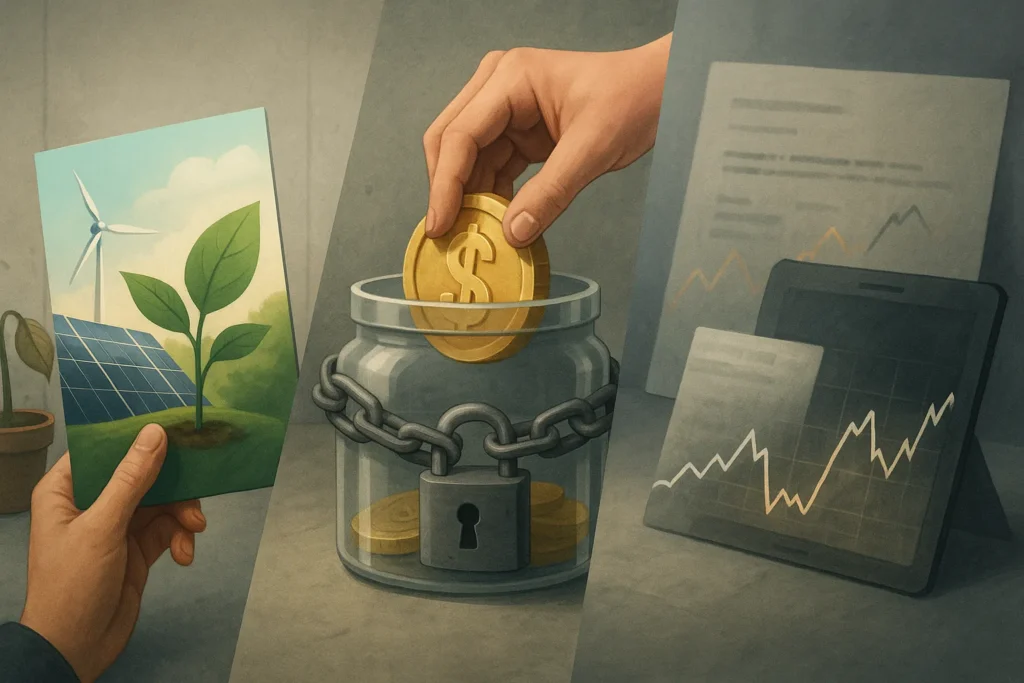
When investors aren’t careful, they face risks like impact washing, regulatory changes, and liquidity restrictions. These risks can lead to supporting projects that don’t deliver real value or facing challenges when market conditions suddenly change.
Watch out for the risks below:
- Impact Washing: Companies often make big claims about their social impact, but they don’t always have the data to prove it. So, it’s important for investors to do their homework and look beyond the hype.
- Liquidity Constraints: You might not know this, but private impact funds lock you in for 7-10 years. Plus, secondary markets aren’t as developed, so early exits usually come with discounts (especially with climate tech).
- Regulatory Uncertainty: Keep in mind that credit phaseouts are raising solar costs by 36-55% and wind by 32-63%. Meanwhile, inconsistent Shariah standards in cross-border Islamic finance are causing many issues. But do you know what’s even worse? Trade restrictions. They can disrupt your supply chains without warning.
Honestly, impact investing is not easy, but with the right knowledge, you can still find your way.
Getting Started With Impact Sectors in 2026
The impact investing market keeps expanding with institutional backing and proven track records. Plus, the diversification across these sectors reduces portfolio risk.
We recommend partnering with experienced fund managers or financial institutions who can identify authentic opportunities and avoid impact washing. And if you’re totally new to this thing, start with green bonds or impact funds that offer liquidity and transparency.
Ready to make your money work for both your goals and the greater good? Reach out to us and let’s chat about the impact sectors that go well with your financial goals.
We’re here to help you create a portfolio that delivers real returns and meaningful social impact.