

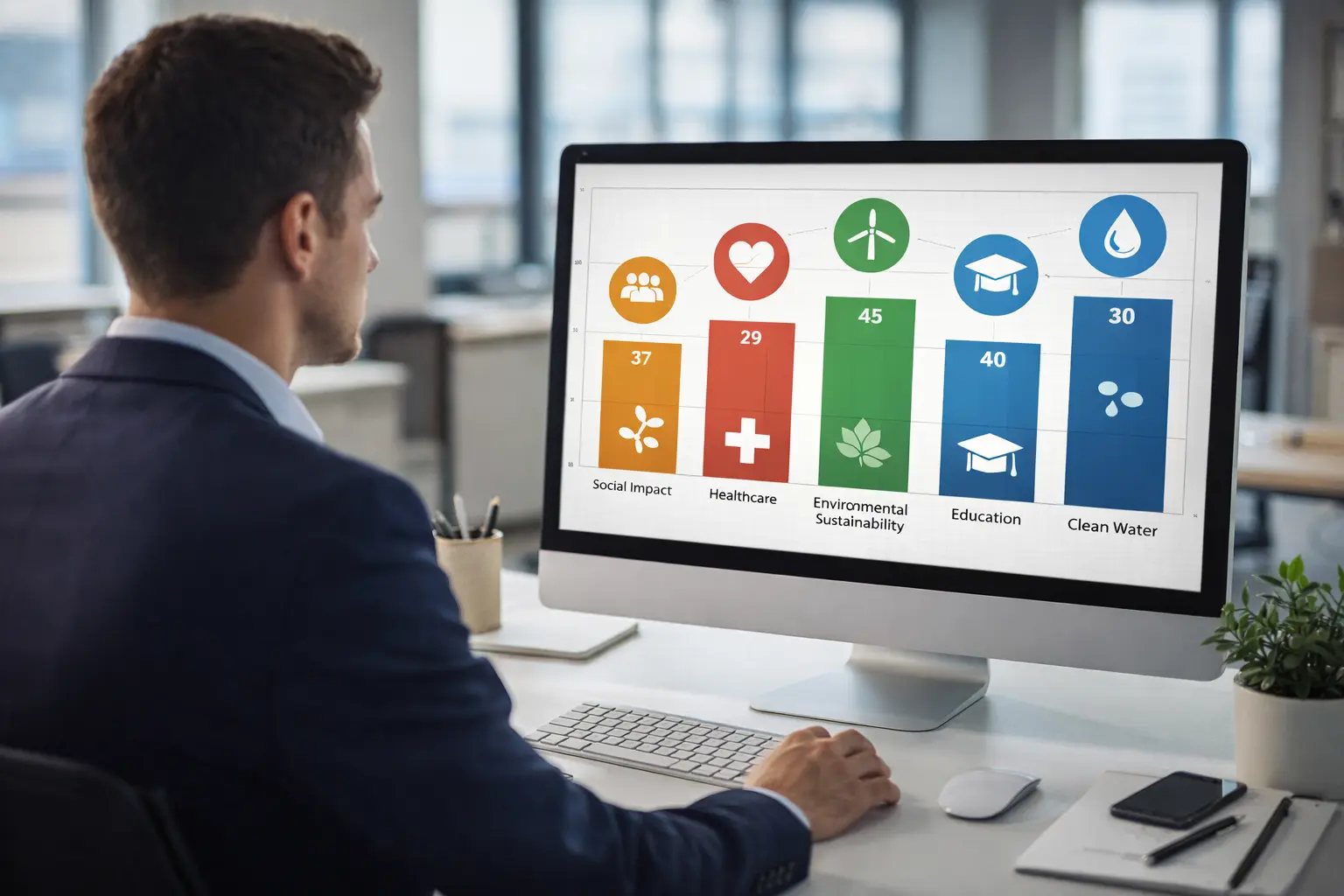
Investors measure social outcomes alongside returns by tracking specific metrics that quantify real-world impact. You count affordable housing units built, patients served at funded clinics, or the number of carbon emissions reduced. These social impact metrics work with your financial data to show what your investments accomplish.
Without proper measurement, you’re investing blindly. Financial returns tell you how much money you made, but they don’t show whether your capital helped anyone or solved real problems. This creates a blind spot when deciding where to invest next, because you lack data on what worked before.
Don’t worry, though. This guide shows you practical methods to measure both financial results and community impact without complex systems. Without any further delay, let’s dive in.
What Are Social Impact Metrics and Why Investors Need Them
Social impact metrics are measurements that quantify the real-world changes your investments create beyond financial gains.
Investors need them because financial returns alone don’t prove your money helped anyone or solved real problems. That’s where impact metrics fill the gap: the data proves where your capital flows and what it accomplishes in communities.
Here’s how it works in practice:
- Foundation Concept: Impact metrics quantify the changes your money creates beyond financial gains. For instance, you can track affordable housing developers built or healthcare clinics delivered to underserved areas. This data proves where your capital flows and what it accomplishes.
- The Risk: Without these measurements, companies practice “impact washing” where they claim social good without backing it up. That’s why frameworks like those from Harvard Business School help you verify if investments create positive change.
Drawing from our work with impact investors, clear metrics from the start prevent scrambling to find proof when stakeholders ask for results. Once you understand what to measure, you can build a system for your strategy.
Setting Up Your Impact Measurement Framework
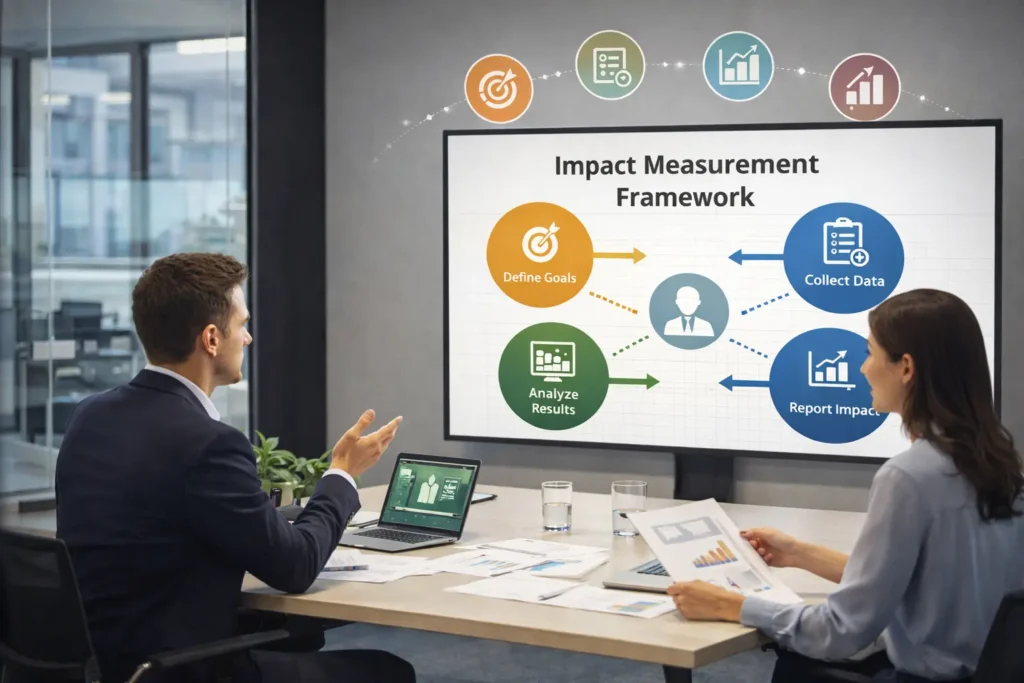
An impact measurement framework will stop you from guessing the change your investments create. On top of that, a solid impact measurement strategy gives you repeatable processes across different portfolios.
Are you still confused? Well, follow these three steps to build your framework.
Define Your Social Impact Goals
Start by choosing specific targets like reducing greenhouse gas emissions or improving healthcare access for 5,000 patients, approximately. That specificity gives you something concrete to measure, unlike vague goals with no clear benchmarks.
Your measurement methods should also match your investment timeline. Because a 10-year infrastructure project needs different metrics than a 2-year small business loan.
Pick Measurement Standards That Fit
Government frameworks provide standardized approaches for impact measurement. For example, the Australian Government’s principles offer guidance on building systems.
Beyond government resources, the International Sustainability Standards Board provides sustainability strategy frameworks, while logic models and theory of change tools help you determine relationships.
Collect Your Starting Point Data
Gather baseline data before investing so you can track actual progress over time. This step prevents vague claims about “improvement” without showing where things started. And when you document initial conditions, you create a clear comparison that proves real impact.
The bottom line is that a clear framework saves you from drowning in irrelevant data later.
Data Collection Methods for Different Investment Types
Our research says that inconsistent data collection creates several challenges for impact investors’ portfolios.
And this is where most of them get stuck, and the root issue is tied directly to investment structure. The type of investment you make determines what data you can collect and how often you’ll receive quantitative data updates.
Each investment type follows a different collection approach.
Investment Type | Data Collection Method | Update Frequency | What You Get |
Direct investments | Company reports + site visits | Quarterly | Deep operational data on specific metrics |
Fund investments | Manager reporting systems | Semi-annual | Aggregated impact data across the portfolio |
Public equities | Third-party data providers | Annual | Corporate sustainability reporting |
Direct investments allow you to request custom metrics and operational data specific to your goals. Basically, you control what gets measured and receive the most detailed social impact picture.
Moving to fund investments, you depend entirely on the manager’s data collection systems. This means less control, but easier portfolio management overall.
Then there are public equity investments that require third-party providers for corporate sustainability reporting directive compliance and ESG data. These providers aggregate information from annual reports and regulatory filings.
Yes, knowing these methods help. But you also need to know how ESG reporting differs from impact measurement.
ESG Reporting vs. Social Impact Measurement

ESG reporting and social impact measurement both track responsible investing, but they measure different things (yes, another acronym to decode). ESG reporting covers environmental, social, and governance factors through ESG metrics.
Think of ESG reporting as a company scorecard covering governance, labor practices, and climate-related risks. Government bodies require this information, which gives you data on how companies operate and manage compliance.
Social impact measurement takes a different approach by focusing on specific outcomes. You’re tracking jobs created and community members helped rather than regulatory checkboxes. The distinction comes down to this: ESG reporting shows compliance, while impact measurement proves the actual change your money creates.
Successful investors combine both approaches. ESG data provides the numbers, but qualitative feedback shows the human side.
Tracking Qualitative Data Alongside Your Financial Returns
Quantitative data gives you half the picture, and qualitative data fills in the rest. When you combine both types, you see the full impact. Three approaches help you collect qualitative information.
- Mixing Data Types: Quantitative data shows scale, like 500 jobs created, while qualitative data reveals how lives changed. The numbers prove reach while the stories add context about what that reach means.
- Site Visits Show Reality: Physical visits help you see what data can’t show you. For example, after visiting a Philadelphia community health clinic, which our fund supported, we learned our $2M investment dropped wait times from 40 minutes to 12 minutes. That experience changed how we evaluate healthcare investments today.
- Collect Direct Feedback: Beneficiary surveys provide input from community members affected by your decisions. Thus, we recommend that you design simple surveys with 5-7 questions that capture experiences without overwhelming respondents.
With data collection covered, let’s look at which specific metrics investors track most often.
Impact Metrics Investors Use Today
Impact metrics help investors track measurable improvements across their portfolios. Most of these metrics fit into three main categories based on your investment goals and sectors. Let’s get into the details.
Employment and Economic Metrics
Job creation numbers tell you how many people found work through your investments.
One Austin fund tracks jobs created per $100K invested and how much wages increased after one year. This approach shows them exactly what economic value they’re creating.
Environmental Impact Tracking
Carbon emissions and greenhouse gas reductions show your environmental impact. Other than climate metrics, you can also track waste diverted, resources conserved, or renewable energy generated. These measurements give you clear environmental performance data.
Social Outcome Measurements
For healthcare investments, track how many patients your funded facilities serve. A Chicago clinic went from 2,400 patients yearly to 7,200 after getting funding. Education metrics work the same way by tracking enrollment and graduation rates.
Another interesting fact is that standardized systems like IRIS help investors compare impact metrics across investments. But bear in mind, your measurement approach should evolve as you gain experience with these metrics.
Continuous Learning: Adjusting Your Measurement Approach Over Time

Your measurement approach should improve with each investment cycle you complete. Take our advice and review your methods every six months. This enables you to identify what needs improvement and what delivers useful impact data.
Let’s not forget, industry standards evolve through continuous learning, which means updates from the International Sustainability Standards Board require you to adjust your approach regularly. This adaptation improves the effectiveness of your impact management strategy.
On the contrary, failed measurements teach valuable lessons about data requirements for future investments. Successful investors track what generates insights, eliminate what doesn’t add value, and refine their approach each quarter. This continuous improvement leads to more informed decisions.
Ready to put these measurement principles into action?
Your Next Steps in Impact Investing Measurement
Impact investing creates real change when you measure both financial returns and social outcomes accurately. Many investors overcomplicate this process with systems that drain time and resources instead of delivering insights. The solution starts with simple impact metrics that align with your investment goals.
In this guide, we walked through measurement fundamentals: framework setup, data collection methods, and ESG reporting distinctions. You learned about qualitative tracking, common impact metrics, and continuous improvement practices.
At the Social Investment Taskforce, we will take you through every step you need to measure impact effectively while earning strong returns. Our experts help you build measurement systems that prove your investments create positive change.
Start tracking your social outcomes today.